How to Create a Cohesive Event Look From Dress to Makeup

Getting dressed for an event sounds simple until you are standing in front of your closet at 6 PM, eyeliner half-done, realizing your bold smoky eye has absolutely nothing to do with the breezy floral number you just zipped up. It happens to the best of us. The problem is not the makeup or the dress individually. It is that we tend to choose them in isolation, as if they live in completely separate worlds. They do not. They are part of the same conversation, and when they speak the same language, the result is something that actually looks intentional.
Here is how to pull it all together, from the moment you pick your outfit to the final swipe of lip gloss.
Start With the Dress, Always
Your dress sets the tone for everything else. It is your anchor. The silhouette, the color, the fabric texture, even the neckline all send signals that your makeup needs to pick up on and carry forward.
When you are shopping for something to wear to a formal event, the dress is doing a lot of the visual heavy lifting already. Think about pieces from Runaway The Label formal dresses, where the construction and detail of the garment are part of the statement. A draped satin gown in deep burgundy already tells you something: this calls for refined, deliberate makeup. Rich skin, defined eyes, a lip that does not fight the dress but deepens it. Meanwhile, a structured ivory mini in crepe fabric reads completely differently. Cleaner. Sharper. Suddenly your makeup leans toward precision rather than drama.
Before you pick up a single brush, look at your outfit and ask: what is the vibe here? Romantic? Sleek? Playful? Moody? That one word becomes your makeup brief.
Match the Energy, Not Just the Color
One of the biggest mistakes people make is trying to literally color-match their makeup to their outfit. Wearing a green dress so you reach for green eyeshadow. It sounds logical, but it often ends up looking costume-y rather than cohesive.
What you want to do instead is match the energy. A sequined dress with an open back is high voltage. That kind of piece wants makeup with the same confidence behind it: a strong brow, a precise wing, or a lip that commits. A soft chiffon dress in blush tones, on the other hand, belongs with something more melted and less defined. Think blended eyeshadow that almost disappears into skin, a wash of peachy color on the cheeks, lips that are nourished rather than outlined.
The texture and weight of your fabric matters too. Heavy, structured fabrics like duchess satin or velvet can hold their own against a bold face. Lighter fabrics like organza or chiffon can get visually overwhelmed if your makeup is too intense.
Skin First, Always
No matter what look you are building toward, skin is the foundation of everything. There is no cohesive event if your skin texture is working against you. Knowing how to make makeup last all day matters even more when you are going into a long night with photos, dancing, or speeches involved.
Prep your skin properly the day before. Hydrate. Use a primer that suits your skin type. If your event involves hours under warm lights or a reception where you will be photographed from multiple angles, a setting spray is not optional. It is the thing that keeps everything looking like you meant it, right until the end of the night.
The Rule of One Feature
Here is the thing nobody tells you clearly: pick one feature to emphasize. One. The eye or the lip. The eye or the cheek. Not all three at full volume. When everything is turned up at once, nothing reads as intentional. It just reads as too much.
If your dress already has its own kind of drama, whether it is a deep plunge, a sculptural neckline, or an extraordinary print, let your makeup be the supporting cast. That might mean a genuinely beautiful skin finish, the faintest wash of color on the eyes, and a lip that enhances without competing.
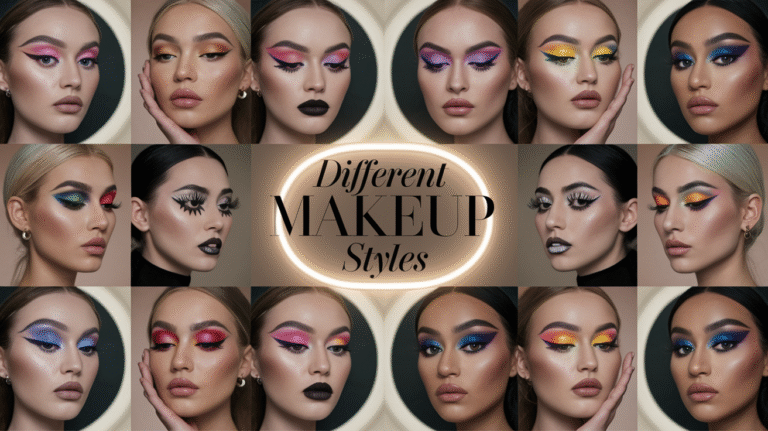
If your dress is more minimal, a sleek column in black or a simple wrap in camel, your makeup has more room to be the statement. This is where you can bring in a classic red lip, a smoky eye, or a graphic liner moment. Any of the different makeup styles that feel too bold for daily wear tend to look extraordinary against a minimalist backdrop.
Neckline and Framing Matter More Than You Think
People underestimate how much the neckline of a dress shapes the makeup decisions around it. A strapless or sweetheart neckline naturally draws the eye upward toward the face and collarbone. If that is what you are wearing, your makeup can be more expressive because the framing is already structured to showcase it.
A high neckline is different. It adds visual weight around the throat and jaw, which means a heavy lip or a very graphic eye can feel crowded. Opt instead for something luminous on the cheekbones and a well-defined but not overwhelming eye.
Off-shoulder styles are interesting because they draw attention to the shoulder and neck line. A bit of highlighter on the clavicle bridges the gap between what the dress is doing and what your face is doing. That continuity is what makes a look feel complete rather than assembled.
Hair Belongs in This Conversation Too
A truly cohesive event look does not stop at the neck. Your hair is part of the equation. An updo exposes your neck and ears, which means earrings and your jawline are suddenly more visible. Your makeup needs to account for that exposure. A sleek updo usually pairs well with a more polished, finished face rather than something lived-in or deliberately undone.
Loose hair, especially something voluminous or wavy, softens everything. If your hair is doing a lot, your makeup can afford to be quieter. If you are going for something architectural with your hair, a dramatic bun or a sculptural style, then a cleaner, more refined makeup approach usually holds the whole picture together better.
The Finish Line: Check It as a Whole
Before you walk out the door, do the full mirror check wearing everything together. The shoes, the bag, the jewelry, and the makeup. What you are checking for is not perfection in each individual element. You are checking for coherence. Does your face feel like it belongs at the same event as your dress? Does the whole picture have a point of view?
Sometimes you will notice that your highlighter is suddenly fighting with the shimmer of your fabric and needs to be toned down. Sometimes you will realize the lip color that looked bold in the tube is actually disappearing against a richly colored gown and needs more intensity. These things only become visible when you see the full look together.
That last check is not vanity. It is editing. And editing is how good becomes great.