How Long Should I Tan Each Side? Safe Timing Guide 2026


I’ve spent years learning how to get a safe tan without burning my skin.
The question of how long should I tan each side depends on your skin type, where you’re tanning, and UV strength.
In this guide, I’ll walk you through exact timing for different skin types, the difference between sun and bed tanning, and how to tan evenly on both sides.
You’ll also learn the warning signs of overexposure and safer ways to get color.
I’m sharing what actually works based on dermatologist guidelines and personal experience.
Let’s get you a safe, even tan.
Quick Answer: How Long Should I Tan Each Side?
For most people, 5 to 15 minutes per side is the safe starting point.
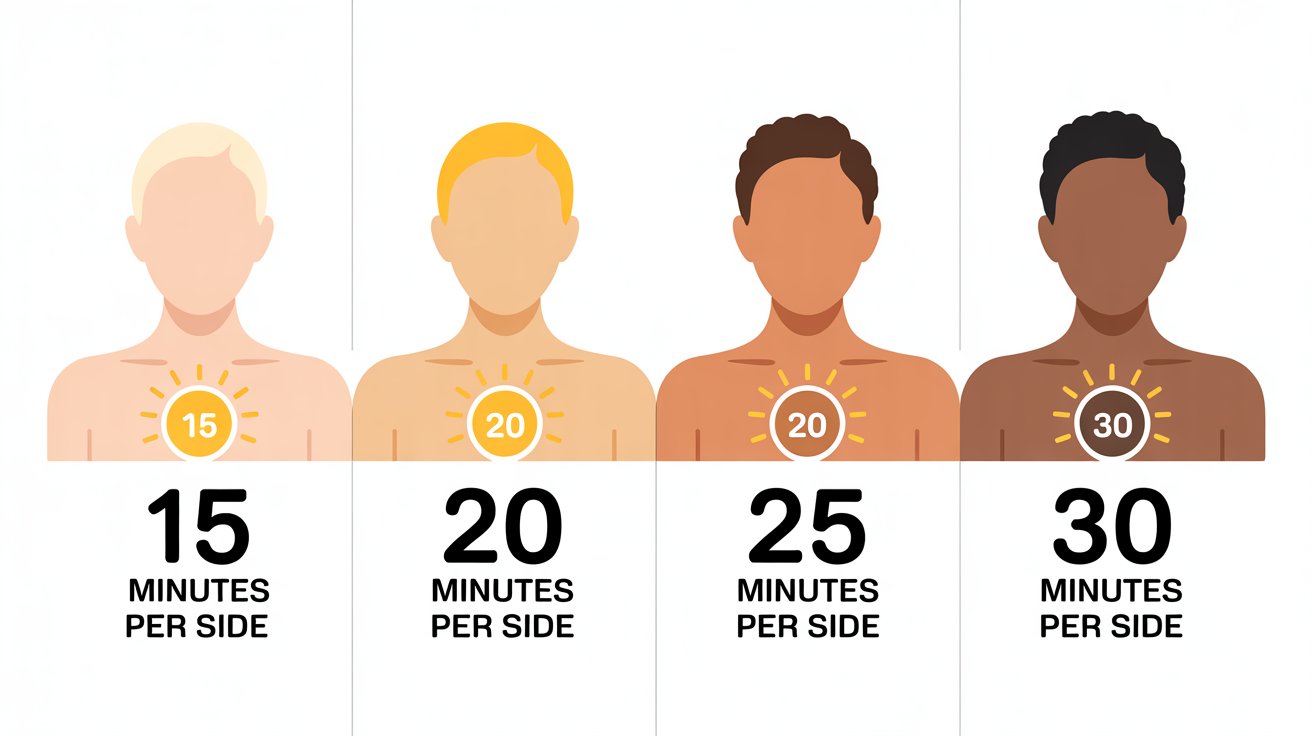
Fair skin types should start with 5 minutes per side. Medium skin types can handle 10 to 15 minutes. Darker skin tones can go 15 to 20 minutes safely. A broad-spectrum mineral sunscreen from Sky and Sol mineral sunscreen can help keep UV protection part of the timing plan, especially for fair or sensitive skin.
These times apply to moderate UV conditions (UV index 6-8). You’ll need less time during peak sun hours (10 AM to 4 PM) and in tanning beds.
Always flip at the same interval. If you tan your front for 10 minutes, tan your back for 10 minutes too. This prevents uneven color.
Start shorter than you think you need. You can always add time in your next session.
Safe Tanning Time Chart by Skin Type
Here’s exactly how long you should tan based on your skin tone.
|
Skin Type |
Minutes Per Side |
Burn Risk |
Hair/Eye Color |
|
Type I (Very Fair) |
5 max |
Very High |
Red/blonde hair, blue/green eyes |
|
Type II (Fair) |
5–8 |
High |
Light brown/blonde hair, light eyes |
|
Type III (Medium) |
10–15 |
Moderate |
Brown/dark blonde hair, brown eyes |
|
Type IV–VI (Dark) |
15–20 |
Low |
Dark brown/black hair, dark eyes |
This chart applies to moderate UV conditions (UV index 6 to 8). You’ll need less time during peak hours and in tanning beds.
The Biggest Factor: Your Skin Type (Fitzpatrick Scale Guide)
Your natural skin tone determines everything about safe tanning duration.
The Fitzpatrick Scale was developed by dermatologist Thomas B. Fitzpatrick in 1975 to classify skin’s response to UV exposure.
This scale breaks skin into six types based on how you react to the sun. This is what dermatologists use to predict burn risk.
Type I: Very Fair Skin
Recommended time per side: 5 minutes maximum
Burn risk level: Extremely high
You’ll know you’re Type I if you have red or blonde hair, blue or green eyes, and freckles. Your skin turns pink or red quickly in the sun.
Honestly, I don’t recommend traditional tanning for Type I skin. The burn risk is too high. If you still want color, stick to self-tanner or spray tans.
Type II: Fair Skin
Recommended time per side: 5 to 8 minutes
Burn risk level: High
Type II folks usually have light brown or blonde hair. You burn first, then maybe tan after several sessions. Your skin might have some freckles.
I always tell Type II friends to be extra cautious. Start with 5 minutes and only add time if you don’t get pink.
Type III: Medium Skin
Recommended time per side: 10 to 15 minutes
Burn risk level: Moderate
This is the most common skin type. You have brown or dark blonde hair and tan fairly well. You might burn after long exposure but it’s not instant.
Type III skin gives you more flexibility. You can build up to 15 minutes per side over a few sessions.
Type IV–VI: Darker Skin Tones
Recommended time per side: 15 to 20 minutes
Burn risk level: Low to very low
These skin types have natural melanin protection. You can handle longer sessions without burning.
But here’s the thing. Even if you don’t burn, UV damage still happens.
According to the American Academy of Dermatology, people with darker skin still face skin cancer risk from UV exposure and should limit sun exposure. You still need sunscreen and time limits.
Why does skin type change tanning duration so much? It’s all about melanin. Fair skin has less melanin, so UV rays penetrate faster. This means quicker burning and less natural protection.
Outdoor vs Indoor Tanning: Timing Differences
Where you tan changes your safe exposure time dramatically.
How Long to Tan Each Side in the Sun
Natural sunlight varies in strength throughout the day.
- Peak hours (10 AM to 4 PM): Cut your time in half. If you normally do 10 minutes per side, do 5 minutes.
- Early morning or late afternoon: You can use your full recommended time.
- Cloudy days: Reduce time by 25%. Clouds don’t block all UV rays.
- High altitude or near water: Reduce time by 30 to 40%. Reflection and thinner atmosphere increase UV exposure.
Check the UV index on your weather app before you tan.
UV index above 8 means you need minimal time, even with darker skin. UV index between 3 to 5 is considered moderate and safest for tanning.
How Long to Tan Each Side in a Tanning Bed
Tanning beds are more intense than natural sun.
- First session: 3 to 5 minutes per side, regardless of skin type
- After 3 to 4 sessions: You can gradually increase to 8 to 10 minutes per side
- Maximum time: Never exceed 12 to 15 minutes per side, even with dark skin
Bed bulbs emit concentrated UVA rays. They penetrate deeper than the sun. This means you need way less time to see results.
According to dermatology research, tanning bed UV exposure can be significantly more intense than midday sun. Most beds have timers. Set it for half your total session and flip at the buzzer.
How to Tan Evenly Without Overexposure
Getting even color on both sides takes more than just timing.
Set a timer. Don’t guess when to flip. Use your phone alarm.
Position yourself flat. Lying on your stomach with arms at your sides, then flat on your back creates even exposure.
Rotate your limbs. After tanning front and back, spend 2 minutes on each side with arms up to tan underarms and sides.
Don’t fall asleep. This is how you get serious burns on one side.
The biggest mistake? Tanning front and back at different times.
If you tan your stomach for 10 minutes today and your back for 10 minutes tomorrow, you’ll get different results. UV strength changes daily.
Safe Tanning Schedule for Beginners
Start slow and build up gradually to prevent burns.
Week 1:
- Session 1: 5 minutes per side
- Session 2 (two days later): 5 minutes per side
- Session 3 (two days later): 7 minutes per side
Week 2:
- Session 1: 8 minutes per side
- Session 2: 10 minutes per side
- Session 3: 10 minutes per side
Week 3 and beyond:
- Maintain 10 to 15 minutes per side depending on skin type
- Tan every 3 to 4 days maximum
Never tan two days in a row. Your skin needs recovery time. I tried daily tanning once and my skin got dry and leathery within a week.
Skip a day between sessions at minimum. Better yet, skip two days. Research shows that melanin production continues for 48 to 72 hours after UV exposure.
Signs You’re Tanning Too Long on Each Side
Your body sends clear warning signals when you’ve overdone it.
- Pink or red skin means you are burned. Stop tanning for at least a week.
- Skin feels hot or tight after your session. You went too long.
- Itching or tingling during or right after tanning. This is an early burn warning.
- Peeling a few days later. You definitely burned and damaged skin.
- Uneven patches of darker color. You moved around too much or tanned unevenly.
- Dry, rough texture. Overexposure strips moisture from skin.
If you notice any of these, reduce your time by half in your next session. And honestly, if you’re burning regularly, it’s time to quit traditional tanning.
Factors That Change How Long You Should Tan Each Side
Several conditions require you to adjust your baseline timing.
Medications: Antibiotics, acne treatments, and some birth control make you burn faster. Check labels for sun sensitivity warnings.
Time of year: Summer sun is stronger. Reduce time by 25% from May to August.
Your location: Southern states and tropical areas have stronger UV. Florida tanning needs less time than Oregon tanning.
Recent exfoliation: Fresh-scrubbed skin burns faster. Wait 24 hours after exfoliating to tan.
Existing tan: Once you have base color, you can add 2 to 3 minutes safely.
Skincare products: Retinols and acids increase sensitivity. Don’t tan within 48 hours of using them.
Safe UV Index for Tanning
The UV index tells you exactly how strong the sun is today.
- UV Index 0 to 2 (Low): You can tan for full recommended time, but results will be minimal
- UV Index 3 to 5 (Moderate): Use your standard timing based on skin type
- UV Index 6 to 7 (High): Reduce time by 25%
- UV Index 8 to 10 (Very High): Cut time in half
- UV Index 11+ (Extreme): Avoid tanning completely or limit to 5 minutes total
Most weather apps show UV index. Check it before every session. I keep mine on my home screen because I got caught off guard too many times.
According to the World Health Organization, UV index above 3 requires sun protection, and above 8, they recommend staying indoors during peak hours.
Dermatologist Safety Guidelines for Tanning
Doctors are pretty clear about this. They don’t recommend tanning at all.
But if you’re going to do it, follow these rules:
- Never exceed 20 minutes per side, even with the darkest skin.
- Use SPF 15 or higher on your face and any spots prone to burning.
- Wear UV-blocking sunglasses to protect your eyes and the thin skin around them.
- Avoid tanning if you have a family history of skin cancer. The risk isn’t worth it.
- Get annual skin checks if you tan regularly. Early detection saves lives.
- Never use tanning beds if you’re under 18. Teen skin is more vulnerable to damage.
- Stay hydrated. Drink extra water before and after tanning sessions.
According to the American Academy of Dermatology, there is no such thing as a safe tan because any color change indicates DNA damage has occurred.
The Skin Cancer Foundation reports that indoor tanning before age 35 increases melanoma risk by 75%.
I’m not here to lecture you. But I am saying know the risks and decide if it’s worth it for you.
Common Tanning Mistakes That Cause Uneven Results
Avoid these errors that ruin your tan and waste your time.
Mistake 1: Not cleaning your skin first
Oil, lotion, and sweat create barriers. They cause patchy tanning. I always shower before a session.
Mistake 2: Inconsistent positioning
Lying differently each session creates different tan patterns. Keep your position the same.
Mistake 3: Skipping moisturizer after
Dry skin doesn’t hold color well. Moisturize immediately after tanning.
Mistake 4: Tanning too often
More sessions don’t mean faster results. They just mean more damage. Stick to it every 3 to 4 days.
How Often Should You Tan for Best Results?
Frequency matters more than session length for safe color.
Maximum frequency: Every 3 days
Ideal frequency: Twice a week
Maintenance (once you have color): Once a week
Your skin cells need 48 to 72 hours to produce melanin after UV exposure. Tanning before that window closes doesn’t speed up the process. The color develops between sessions, not during them.
Safer Alternatives to Traditional Tanning
You can get color without UV damage. Look, UV tanning damages your skin. Period.
These options give you color without the harm:
- Self-tanning lotions: Takes practice but gives natural-looking color. Reapply every 5 to 7 days.
- Spray tans: Professional application lasts 7 to 10 days. No UV exposure at all.
- Tanning mousse: Easy to apply at home. Dries fast and looks natural.
- Gradual tanning moisturizers: Build color slowly over several days. Very forgiving for beginners.
According to dermatologists, self-tanners using DHA (dihydroxyacetone) are the only safe way to get a tan. They work by temporarily staining the outer layer of skin without any UV exposure.
Conclusion
So how long should you tan each side? Start with 5 to 10 minutes depending on your skin type. Fair skin needs the shorter end. Darker skin can handle 15 to 20 minutes safely.
Always match your timing on both sides. Use a timer and flip at the exact interval. Check the UV index and adjust for weather, location, and time of day.
Watch for warning signs like redness or itching. They mean you’re going too long. Build up gradually over weeks, not days.
Remember that tanning damages skin no matter how carefully you do it. Research suggests that UV exposure is a leading cause of premature skin aging. The safest tan is a fake tan.
What’s your biggest concern about getting an even tan? Comment down and share your thoughts.
Frequently Asked Questions
Can I tan for 30 minutes on each side?
No, 30 minutes is too long for any skin type. Even dark skin should max out at 20 minutes per side to reduce cancer risk.
Should you flip while tanning?
Yes, always flip to tan both sides evenly. Set a timer for equal minutes on front and back to prevent uneven color.
What is the best time of day to tan?
Early morning (7 to 10 AM) or late afternoon (4 to 6 PM) when UV index is moderate. Avoid peak hours between 10 AM and 4 PM.
Can sunscreen prevent tanning?
Yes, SPF 30 or higher blocks most tanning. Use SPF 15 or lower if you want some color while reducing burn risk.
How long until I see tanning results?
Light color appears after 2 to 3 sessions over one week. Noticeable tan develops after 5 to 7 sessions over 2 to 3 weeks.
Should I tan longer on my back than my front?
No, keep timing equal on both sides. Your back and front need the same exposure time for even color throughout.
Is 10 minutes in a tanning bed equal to sun?
No, beds are stronger. 10 minutes in a bed can equal 30 to 40 minutes in moderate sun due to concentrated UVA rays.