Why Bringing Art Into Your Home Is One of the Best Self-Care Moves You Can Make


Most self-care conversations start with your face and your body. Serums, supplements, sleep schedules. And those things matter. But there’s a layer of your daily experience that rarely comes up in wellness circles: the walls you wake up to every morning.
Your environment shapes your mood more than most people give it credit for. A cluttered, blank, or visually uninspiring space doesn’t just look boring – it can actively drag on your mental state. Flip that around, and a space filled with something that genuinely moves you does the opposite. Art – both displaying it and making it – is one of the most underrated additions to a real self-care practice. Not a luxury, not a trend. A legitimate, research-backed way to feel better on a daily basis.
Art on Your Walls Does More Than Look Good
The idea that your visual surroundings affect your psychology isn’t new, but the scale of it might surprise you. According to a 2024 Saatchi Art survey of more than 600 Americans, 88% said they’d consider art or art therapy as part of their personal wellness plan, and 87% of people who make art said it provides stress relief or a measurable positive impact on their well-being.
There’s a reason those numbers are so high. Your brain processes visual information constantly, and what it sees contributes to your baseline emotional state throughout the day. Nature-inspired imagery specifically taps into what designers call biophilic principles – our built-in human preference for organic shapes, greenery, and natural color palettes. Floral and botanical art fit squarely here. It’s not decorating for aesthetics alone; it’s creating an environment that signals safety and calm to your nervous system.
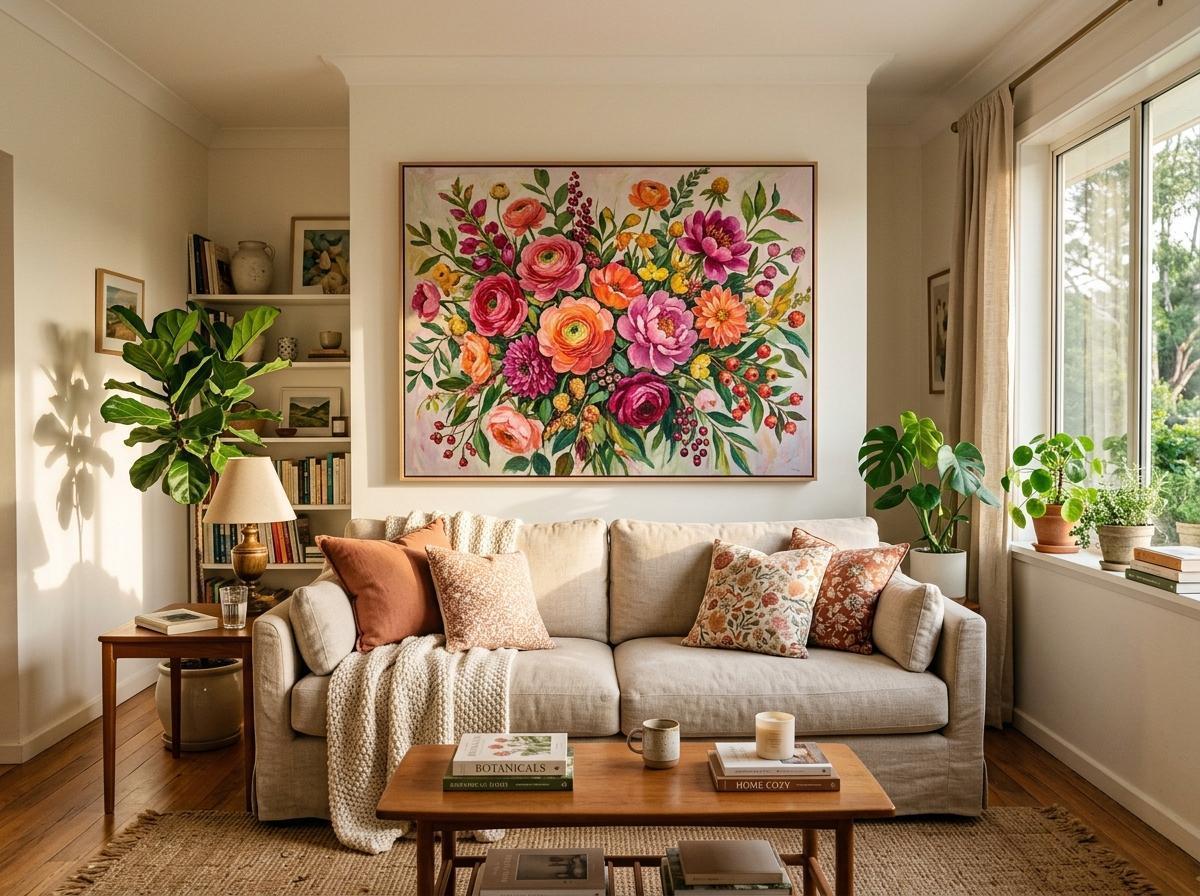
If you want somewhere concrete to start, a large floral painting is one of the simplest ways to shift the emotional register of a room. Scale matters more than most people expect. A single statement piece in a bedroom or living room does more work than five small prints scattered across a wall – it gives the eye a place to rest and the room a clear emotional center.
The wall art market is not a niche interest, either. Paintings and prints hit an estimated $64 billion in 2024, accounting for 34.8% of the global wall decor market, according to data from Grand View Research. People are already spending here. The question is whether they’re spending with intention.
The Science Behind Making Art Yourself
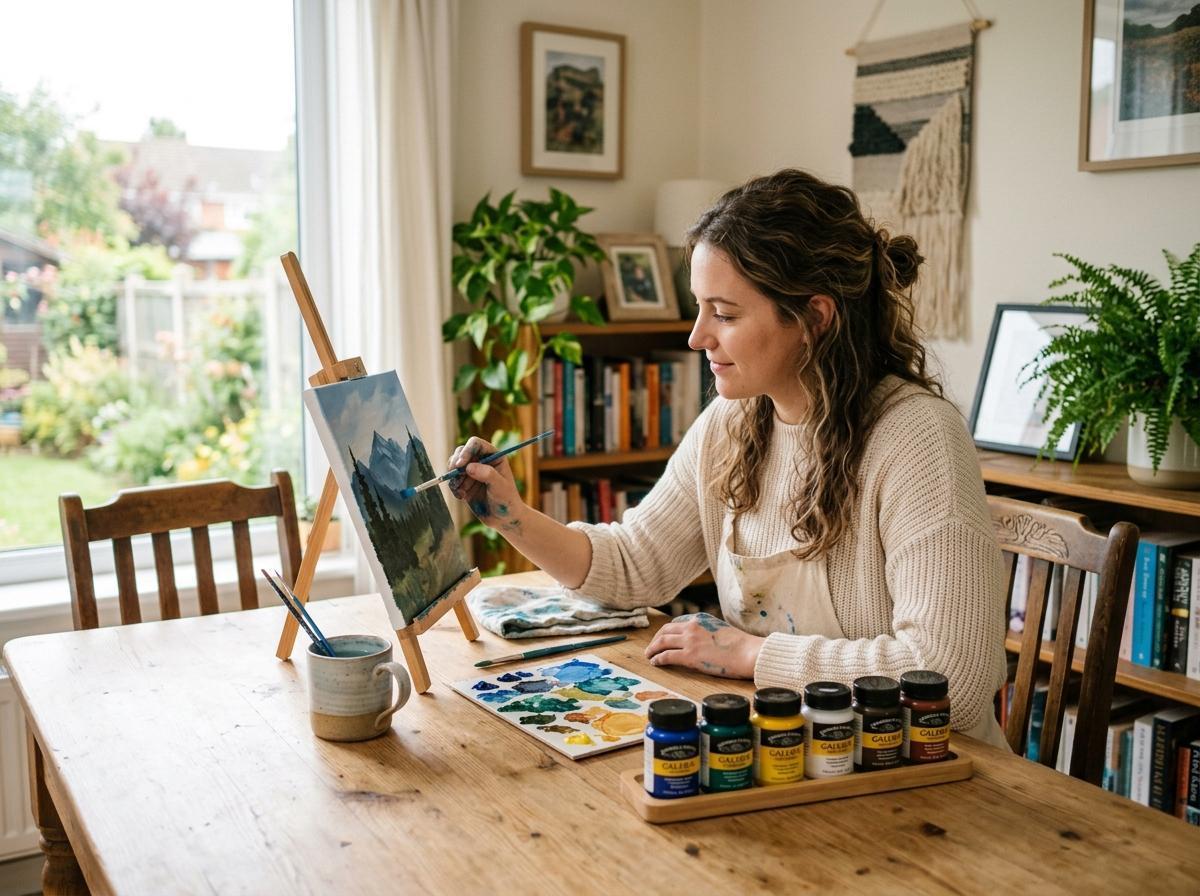
There’s a difference between looking at art and making it, and the benefits aren’t the same – though both are real.
A 2023 study of 93,000 adults across 16 countries, published in Nature Medicine, found that people with creative hobbies reported better health, more happiness, fewer depression symptoms, and higher life satisfaction. The findings held across every country studied. Harvard Health reported on the research and noted that the consistency across cultures made the results especially compelling.
Then there’s the clinical evidence. A 2024 meta-analysis published in JAMA Network Open examined 50 studies with 2,766 participants and found that active visual art therapy produced a statistically significant positive effect on mental health outcomes – specifically depression, anxiety, and quality of life. The effect size was modest but real and consistent.
What this means practically: you don’t need a licensed art therapist or a clinical program. Accessible creative activity – the kind you do at home, on a Tuesday night, with a cup of tea – appears to work through the same basic mechanisms. And that has serious implications for how we think about taking care of yourself from the inside out, because self-care isn’t only what you put on or in your body. It includes how you spend your attention.
Why Paint by Numbers Is the Self-Care Hobby You Haven’t Tried Yet
“I’m not artistic” ends more conversations than any other objection. But paint-by-numbers sidesteps the problem entirely. The canvas arrives pre-printed with numbered sections, each number corresponding to a specific color. You don’t need to decide what to paint, where to put it, or whether your proportions are right. The only job is to follow the guide and fill in the sections.
That constraint is actually a feature, not a limitation. The focused, repetitive action of painting numbered sections creates a flow state – a quality of absorbed attention that quiets the mental noise that builds up through a normal day. It’s the same mechanism that makes journaling or breathwork effective. Your brain gets just enough of a task to stop ruminating, but not so much that it stresses out.
The numbers back up the interest. The global adult paint-by-numbers market is growing at 7.1% per year through 2033, and search data recorded an 18.22% month-over-month jump in searches for paint-by-numbers kits in June 2024, according to Accio market research. Floral and botanical designs consistently rank among the top-selling categories.
If you want to give it a go, you can learn more here for a range of floral and botanical kits designed for beginners.
You Don’t Have to Be an Artist to Start
Whether you’re buying original art for your walls or picking up a creative kit, the principle is the same: it’s an intentional choice to add something meaningful to your environment. That kind of deliberate decision is exactly what self-care looks like at its core.
Think about why a skincare routine feels good beyond the physical results. Part of it is the ritual – choosing to invest a few minutes in something that’s only for you. A good candle, a specific playlist, a face mask on a Friday night. Art fits into the same category. You’re not solving a problem. You’re creating conditions for feeling good.
There’s also a bonus that comes with making your own art: it goes on your walls when you’re done. A completed paint-by-numbers canvas isn’t a craft project you tuck into a drawer. It’s something you made that now lives in your space and contributes to the visual environment you wake up to every day. That’s a satisfying loop – and it connects back to how appearance shapes how you feel day to day: when your surroundings reflect care and intention, you feel it.
Making It Part of Your Routine
The reason most people don’t do this isn’t that they don’t want to. It’s because “do something creative” is vague, and vague habits don’t stick.
Specific ones do. Try 20 to 30 minutes a few evenings a week. Pair it with something you already do: music you love, a podcast you’ve been meaning to start, or just quiet with a drink. Treat it the way you’d treat a wind-down skincare routine – not as a project, but as a signal to your brain that the working part of the day is over.
If you need external motivation, the Harvard Health research makes a plain case for it. The Nature Medicine data suggests that having a hobby – any hobby, but especially a creative one – has consistent mental health benefits that show up across age groups, income levels, and cultures. You don’t need perfect conditions to start. You need 20 minutes and something to paint.
A Final Thought
Self-care doesn’t always need a new product, a wellness retreat, or a carefully curated supplement stack. Sometimes it’s quieter than that. A piece of art that genuinely moves you on the wall. A creative habit you can come back to at the end of a long day.
The combination of a meaningful piece of art in your space and a simple creative practice you return to regularly is genuinely good for you – not just in a feel-good sense, but in a measurable, documented way. That’s worth building into your routine.