How Needle-Free Jet Injectors Are Changing Drug Delivery

xFor most people, an injection means a needle, and it is a familiar part of modern medicine. But it is not what people really enjoy. The fear of needles, discomfort during injections, accidental needlestick injuries, and the disposal of used sharps have all led researchers to look for better ways to deliver medicines.
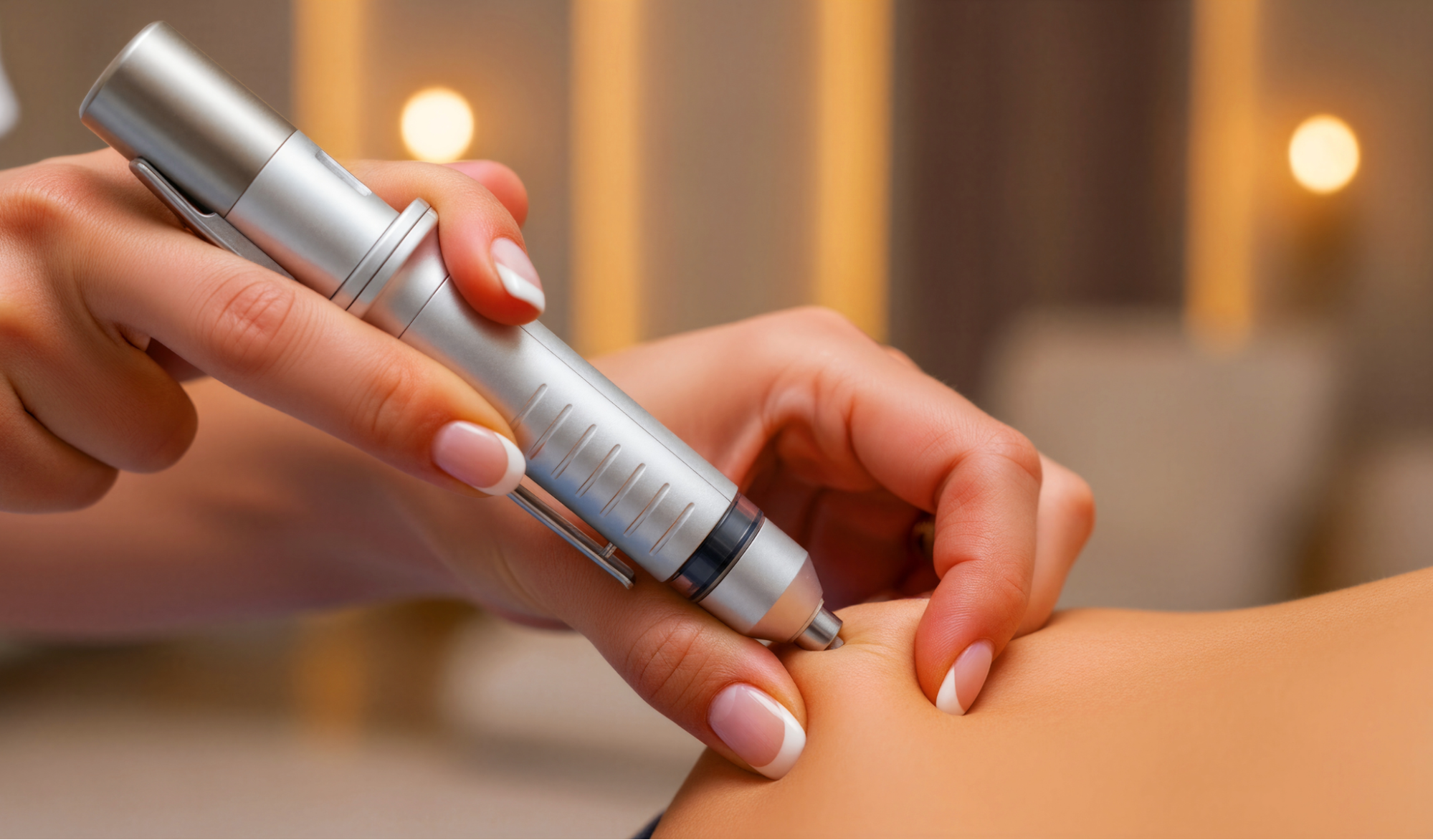
One technology that has been receiving renewed attention is the needle-free jet injector. Instead of using a hollow needle to push medication through the skin, these devices use a narrow, high-pressure stream of liquid to penetrate it and deliver the drug to the target tissue.
The basic idea has been around for decades. Jet injectors were used in large-scale vaccination efforts long before today’s digitally controlled medical devices appeared. What is different now is the level of engineering behind newer systems. Improvements in pressure control, nozzle design, disposable components and delivery precision are giving jet injection another look.
Nasal drug delivery is another needle-free approach gaining attention, using the nasal passages to administer certain medicines while potentially offering a more convenient alternative to injections.
What Is a Needle-Free Jet Injector?
A needle-free jet injector is a medical device made to deliver liquid medication without a conventional hypodermic needle. It works by generating enough pressure to force the medication through a very small opening, producing a high-speed jet that can penetrate the skin.
Depending on the device and the treatment, the medication may be delivered into the intradermal, subcutaneous or intramuscular layers. They are called by various terms, including needleless injectors, jet injectors and disposable syringe jet injectors.
The mechanics are relatively simple to describe, even though the engineering can be quite sophisticated. Energy stored in the device moves a piston or similar mechanism, rapidly increasing pressure behind the medication. The liquid is then forced through a tiny nozzle at high velocity.
That jet essentially creates its own temporary pathway through the skin.
The performance of the system depends on several variables, including nozzle diameter, pressure, jet velocity, formulation properties and the characteristics of the tissue being treated. These factors influence both how deeply the medication travels and how it spreads after entering the tissue.
Why Are Researchers Looking Beyond the Needle?
The appeal starts because of something simple: many people simply do not like needles.
Needle aversion can make vaccinations and other injectable treatments more stressful. Removing the visible needle may make certain procedures more acceptable, particularly for people who experience significant anxiety around injections.
There are practical benefits, too. Needle-free systems do not produce the same type of used-sharp waste associated with conventional injections. They can also reduce the risk of accidental needlestick injuries for healthcare workers and patients.
Some needle-free systems may offer another advantage in vaccination programs: dose sparing. Intradermal administration can sometimes achieve an immune response with a smaller quantity of vaccine than conventional intramuscular administration. That could be valuable when vaccine supplies are limited or when large numbers of people need to be vaccinated.
Jet Injection Has a Long History
The concept of jet injection is not new.
Jet injectors have been used for mass vaccination for many decades. This included major public-health campaigns. Earlier generations demonstrated that vaccines and medications could be delivered effectively without a needle, but the technology also developed a reputation for problems such as pain, bruising, splashing, inconsistent delivery and concerns about cross-contamination.
Those disadvantages contributed to the widespread adoption of conventional needle-and-syringe injections.
Modern devices are designed with many of those problems in mind. Single-use delivery components can help address contamination concerns, while improvements in pressure and delivery control allow manufacturers to tailor the injection more closely to the target tissue.
Recent research is also looking at digitally controlled and electromechanical systems. These devices may allow much finer control over the pressure pulse and delivery profile than some earlier mechanical systems.
That precision matters. The depth at which a drug is deposited can influence absorption, distribution and ultimately treatment performance.
Where Could Needle-Free Injection Be Used?
Vaccination is one of the most established applications.
A 2020 review by the Canadian Agency for Drugs and Technologies in Health (CADTH) examined 14 randomized controlled trials comparing needle-free injectors with conventional needle-and-syringe vaccination. The studies covered influenza, inactivated polio, measles-mumps-rubella, DTP-HB-Hib, HPV and BCG vaccines. Overall, the review found that immune responses with needle-free injection were similar to those achieved with conventional injection for several vaccines, although results varied by vaccine, injection route and dosing strategy.
More recent research continues to investigate needle-free delivery for vaccines such as influenza, hepatitis B, typhoid, rabies and measles. A 2026 review found that published studies have reported antibody responses and seroconversion rates comparable with conventional injection in the vaccine applications examined.
Insulin is another area of interest. Jet injectors have been investigated as an alternative for delivering insulin into subcutaneous tissue, with some research suggesting that absorption may occur more rapidly than with traditional injection methods. The actual result, however, depends on the specific device, formulation and circumstances of administration.
Researchers have also investigated jet injection for local anesthetics, corticosteroids and other medications. In dermatology, for example, needle-free systems have been studied for applications involving local anesthesia, steroids and other treatments.
What Does “Type of Needle-Free Syringe” Mean?
There is an unusual side to the terminology surrounding this technology. Searches for “type of needle-free syringe crossword” can bring up crossword clues rather than medical information.
In a clinical context, though, a needle-free jet injector should not simply be thought of as an ordinary syringe with the needle taken off.
The mechanism is fundamentally different. A conventional syringe relies on a needle to create the route through the skin. A jet injector generates a high-speed liquid stream that penetrates the skin without a needle.
That distinction is important because the device has to control factors such as pressure, nozzle geometry and delivery depth. It is a specialized drug-delivery system rather than merely a modified syringe.
Needle-Free Does Not Mean Risk-Free
The technology has obvious advantages, but it still has limitations.
Earlier jet injectors were associated with concerns about pain, bruising, tissue injury, splashing and infection control. Modern designs have addressed some of these issues, but the underlying need for careful device design and proper administration has not disappeared.
Formulation compatibility is another challenge.
A drug has to withstand the physical conditions created during injection. High-speed delivery can expose a formulation to rapid pressure changes and mechanical forces. This becomes particularly important when researchers are working with complex biological products such as vaccines, proteins and other sensitive formulations. Recent research has identified formulation stability as an important area for further investigation.
There is also no guarantee that a device proven effective for one medication will work equally well with another. Each drug, formulation, delivery depth and injector combination needs to be evaluated on its own merits.
How Intranasal Drug Delivery Fits Into the Bigger Picture
Needle-free drug delivery is not limited to pushing medication through the skin.
Intranasal drug delivery is another area attracting substantial pharmaceutical research. Instead of injecting medication, nasal formulations deliver an active ingredient through the nasal cavity.
The approach has several potential advantages. The nasal mucosa has a rich blood supply, and nasal administration can avoid the gastrointestinal tract and, for some drugs, reduce exposure to hepatic first-pass metabolism. Researchers are also investigating whether the nasal route can help deliver certain medicines toward the central nervous system.
Nasal drug delivery is not without obstacles, however. The nasal cavity has natural mechanisms for clearing foreign material, and drugs can be removed through mucociliary clearance before sufficient absorption occurs. Some medicines also have poor bioavailability when administered nasally, while certain formulations can irritate or damage the nasal mucosa.
For that reason, nasal delivery and needle-free injection should not be viewed as competing technologies in every case. They are different approaches to the same broader problem: finding more effective and practical ways to get medicines where they need to go.
What Could Come Next?
The future of the needle-free jet injector is unlikely to involve replacing every needle and syringe.
Instead, its strongest role may be in situations where the technology offers a clear practical advantage. Vaccination programs, certain injectable medicines and treatments that could benefit from reduced needle exposure are obvious areas of interest.
The technology could become more useful as engineers gain better control over jet velocity, pressure, penetration depth and dose delivery. Digital controls may also make it easier to customize the injection profile for different medications and target tissues.
At the same time, pharmaceutical developers are exploring other alternatives, including intranasal formulations, wearable delivery systems and other nontraditional routes.
The needle is essential for countless treatments. But it no longer has to be the only option.
Needle-free jet injectors represent a shift in thinking about drug delivery. Instead of asking how to make the traditional injection slightly better, researchers are asking whether the needle is necessary in the first place. For selected medicines and patients, that change in perspective could make drug delivery more comfortable, more efficient and easier to manage.