Are At-Home Hair Removal Devices Really Effective?


Are at-home hair removal devices really worth your time, or are they just a convenient compromise? The short answer is: yes, they can work.
However, as always, there is a “but” — their results are more modest and depend heavily on how you use them and what you expect.
Some people start researching hair removal after comparing in-clinic treatments with home options, whether they’re looking into laser hair removal Great Neck NY, LA, Austin, or anywhere else where professional services are widely available.
At-home devices promise privacy, lower cost, and flexibility, but what do they deliver?
Keep reading.
How At-Home Hair Removal Devices Work
At-home hair removal devices are made to slow hair growth, not eliminate it permanently.
Most of the options you’ll see on the market use intense pulsed light (IPL) rather than true medical-grade lasers. And while it’s true that IPL and laser treatments target hair pigment in a similar way, the technology and strength behind them are different.
When you use an at-home device, light energy is absorbed by the melanin in the hair shaft. That heat travels down toward the follicle and weakens it, making future growth slower and finer.
Because these devices are made for unsupervised use, their energy levels are intentionally lower than what you’d find in a clinic (one of the main reasons results take longer and are less obvious or dramatic).
Hair growth also happens in cycles, and only hairs in the active growth phase respond to light-based treatments. This means:
- you won’t see results after one session
- missed treatments mean less effectiveness
- patience and consistency matter more than power
So, yes, these tools do work, but only when you use them exactly as intended and understand how they work.
How Effective Are At-Home Devices Compared to Professional Treatments?
If you’re deciding between an at-home device and in-clinic laser sessions, effectiveness is usually the main concern.
Clinical lasers use higher energy and are adjusted by a trained provider based on your skin tone, hair thickness, and treatment area.
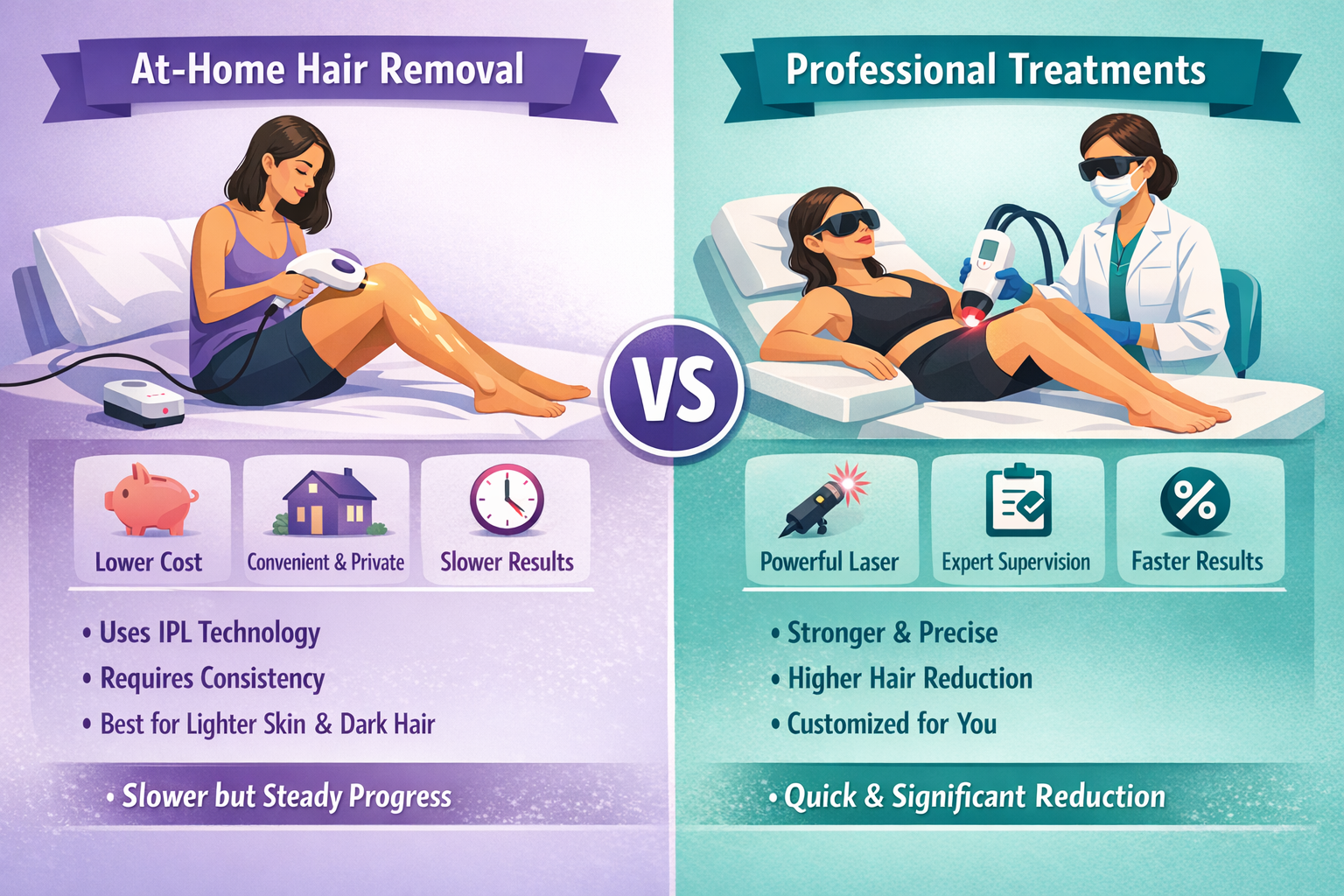
In a comparative clinical evaluation of a home-use laser and a professional diode laser, the professional device achieved hair reduction in the mid-to-high 80% range in the underarm area, while the at-home device reduced hair closer to the 50% range over the same period.
Both options showed mild, temporary side effects, but the difference in results was clear.
Why does this gap exist?
- professional devices penetrate deeper and deliver more consistent energy
- treatments are spaced and adjusted by someone trained to track progress
- clinics can safely treat stubborn or dense areas more aggressively
At-home devices, by contrast, are built with safety limits that reduce risk but also limit impact. Don’t be mistaken, you can still see visible improvement, especially with consistent use, but progress is slower and tends to plateau sooner.
This doesn’t mean at-home tools are ineffective. It just means they work best when your expectations match what they’re designed to do.
Who Gets the Best (and Worst) Results With At-Home Devices
Like anything else, at-home hair removal devices don’t deliver the same results for everyone. Your skin tone, hair color, and even age all influence how well these tools work.
Light-based hair removal relies on contrast. Dark hair absorbs light better than light or gray hair, and lighter skin allows that energy to focus on the follicle rather than the surrounding area.
The treatment area is another factor. Smaller zones like the underarms or lower legs usually respond better than hormonal areas such as the face or bikini line, where regrowth tends to be more stubborn.
There’s also thickness, as coarser hair often shows better early response than fine hair.
As for the age, many clinics have clear guidelines around how old you have to be to get laser hair removal, and often require parental consent for minors.
At-home devices don’t always state age limits as clearly, but younger users may get inconsistent results if hair growth patterns are still changing.
Safety, Side Effects, and Common Misconceptions
As we already mentioned, one of the main reasons at-home devices use lower energy levels is safety.
When used correctly, most people experience only mild, short-term reactions, such as redness, warmth, or some sensitivity in the treated area. All usually disappear within a few hours.
There’s a clinical research on low-energy IPL devices used at home that supports this. In one trial, 95% of participants noted visible hair reduction, while only 25% saw mild skin redness after sessions.
Nevertheless, mild reactions are still possible. A common concern is skin itching after laser hair removal, which can also happen with at-home treatments. There’s a simple explanation for this: heat temporarily irritates the skin and/or dries it out.
In most cases, it’s short-lived and improves with moisturizer, cool compresses, and avoiding heat or friction for a day or two.
Misuse is where problems tend to arise. Treating skin that’s too dark for the device, skipping patch tests, or increasing session frequency to “speed things up” can all raise the risk of irritation.
So, are these devices worth it?
Yes, they are. If your goal is noticeable thinning and slower regrowth over time, they can meet that need.
But, if you’re aiming for the highest possible reduction in the shortest timeframe, it’s best to go for a professional treatment.