Why Deer Antler Velvet Is the Skin Repair Ingredient You Haven’t Tried Yet

The beauty industry has a reliable cycle. An ingredient that has been used in traditional medicine or niche clinical settings for decades suddenly appears everywhere at once, rebranded as a discovery.
Retinol went through it first, then niacinamide, and then hyaluronic acid. The pattern is consistent enough that it is worth paying attention to what is sitting in the earlier part of that curve, because that is where the genuinely interesting formulations tend to live before the mainstream catches up and dilutes everything into a sheet mask.
Deer antler velvet is at that point right now. It has a centuries-long history in Eastern medicine, a growing body of Western research behind it, and a biological profile that is genuinely unusual compared to anything else used in topical skincare.
The question worth asking is not whether it works but why it has taken this long to arrive in serious formulations, and what it actually does once it gets there.
This article explores the science behind deer antler velvet as a skin repair ingredient, what distinguishes it from the collagen and growth factor alternatives already on the market, and how to find a formula that uses it at a level where it makes a real difference.
The Ingredient Getting Serious Attention
BioVelvet has built its entire product line around this shift. Their Recovery Cream centers on a proprietary deer antler velvet extract sourced from New Zealand, where the farming and harvesting of velvet operates under some of the most rigorous welfare and quality standards in the world.
What sets the extract apart is not just what it contains but how those contents function together. The growth factors do not sit alongside the collagen in the formula as separate actives. They arrive as part of the same biological complex that produces collagen in the deer’s own tissue, which means the signaling mechanism and the structural protein are delivered in the relationship they already have in nature.
The formula also draws on aloe vera for barrier soothing, Dead Sea minerals for texture restoration, tea tree oil for antimicrobial support, and ginkgo biloba for antioxidant protection. It is dermatologically tested, free from steroids and synthetic preservatives, and has been used successfully on skin conditions ranging from eczema and psoriasis to radiation burns and post-procedure recovery.
Research in deer antler velvet has been building steadily. A piece published in Forbes Georgia examined the biological complexity of deer velvet and its potential across recovery applications, noting the unusually high concentration of growth factors, collagen precursors, and bioactive proteins that make it structurally distinct from other animal-derived ingredients.
The coverage reflects a broader metamorphosis in how the ingredient is being taken seriously outside of its traditional context.
What Deer Antler Velvet Actually Is
Most people who have not encountered the ingredient before assume it involves the hard, calcified antler material.
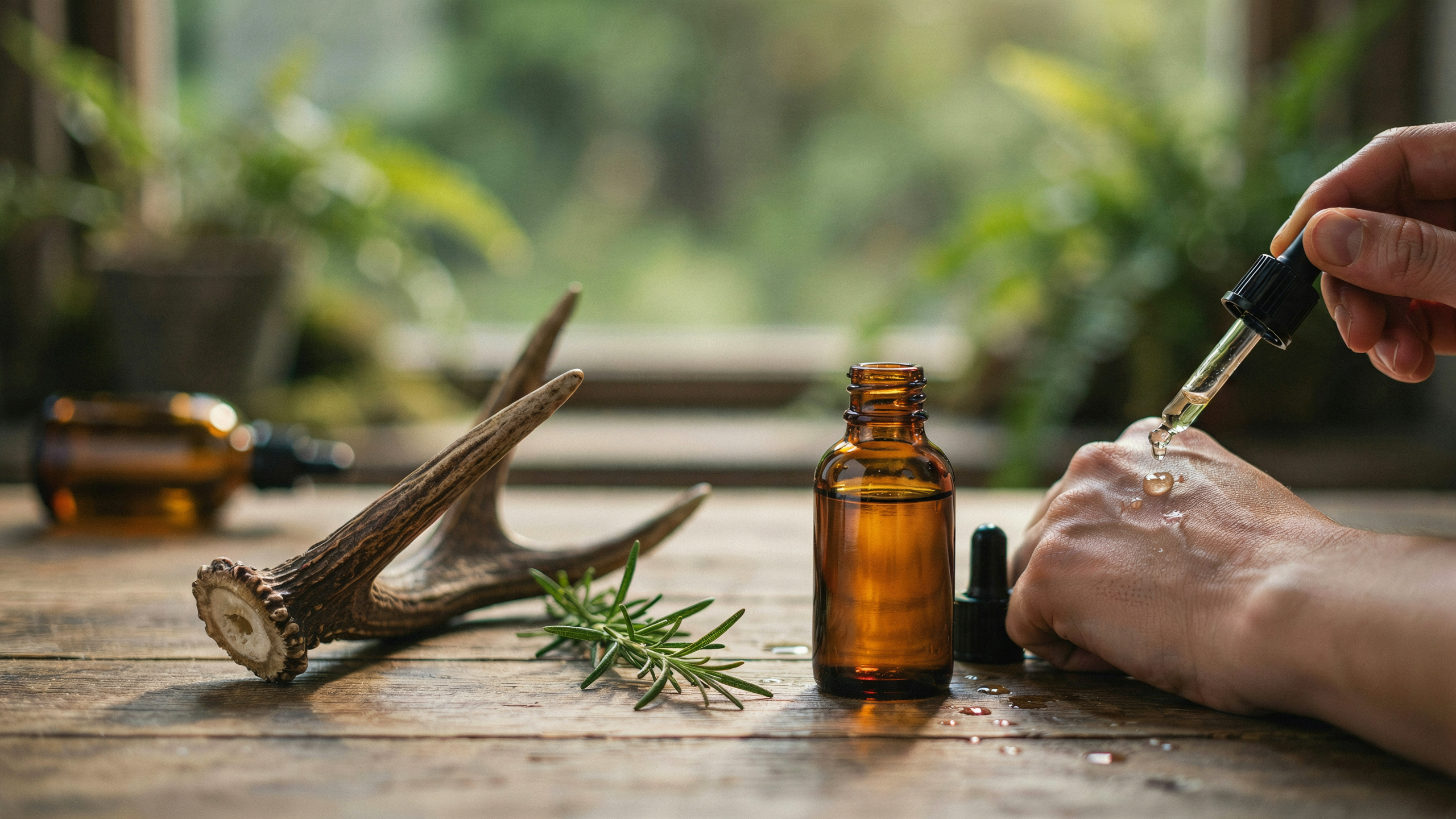
Velvet refers to the growth stage, the weeks during which the antler is covered in a soft, vascularized tissue that supplies the rapid cell division needed to grow what is, proportionally, the fastest-growing tissue in the mammalian kingdom. At peak growth, antlers can extend by up to two centimeters a day. The velvet that enables that growth is dense with the biological signals needed to produce collagen, new blood vessels, and connective tissue at speed.
That same biological profile, when extracted carefully and applied topically, gives the skin access to growth factors it would otherwise have to produce on its own at a much slower rate.
The fibroblasts responsible for collagen synthesis respond to those signals the same way they would to the skin’s endogenous repair triggers, but with greater intensity and speed. It is a mechanism that marine collagen and bovine collagen simply do not replicate, because neither source contains growth factors in the same concentration or in the same intact biological relationship.
| Feature | Deer Antler Velvet | Marine Collagen | Bovine Collagen |
| Contains growth factors | Yes, naturally occurring | No | No |
| Collagen continuously regenerates | Yes, annual cycle | No | No |
| Bioactive proteins intact | Yes | Partially | Partially |
| Traditional use in medicine | Centuries of Eastern use | Limited | Limited |
| Suitable for sensitive skin | Yes, dermatologically tested | Varies | Varies |
Why Growth Factors Change the Repair Equation
Applying collagen topically has always had a bioavailability problem. Collagen molecules are large, and the skin’s barrier is designed to keep things out.
What reaches the deeper layers where fibroblasts operate is a fraction of what is applied to the surface, which is why collagen creams often deliver short-term surface hydration without the structural improvement they promise.
Growth factors sidestep that problem by working at the signaling level rather than the structural level. Instead of trying to deliver finished collagen through a barrier built to resist it, they communicate with the cells that produce collagen natively, prompting them to increase output.
The results accumulate over time rather than arriving and washing away, and the collagen produced is structurally integrated into the skin’s own matrix rather than sitting as a film on the surface.
For skin dealing with acne scarring, that distinction is particularly significant. Fading acne scars takes time precisely because the remodeling of scar tissue requires sustained fibroblast activity, not a single application of a surface ingredient. Growth factors support sustained activity in a way that conventional collagen delivery cannot.
How to Tell a Serious Formula from a Marketing Exercise
The ingredient’s growing profile means it will attract the same thing every trending skincare ingredient attracts, which is a wave of products that use it in quantities too small to matter while centering it in the marketing. Here is what distinguishes a formula worth trying from one riding the trend.
- Source matters: New Zealand deer antler velvet offers higher quality and welfare standards than generic sources.
- Natural complexity: Whole-velvet extracts preserve growth factors and proteins in their original biological context.
- Full-spectrum repair: Effective formulas combine regenerative, anti-inflammatory, barrier-supporting, and antimicrobial ingredients.
- Real-world testing: Studies on damaged or compromised skin are more relevant than testing on healthy skin alone.
- Clinical proof: Evidence from eczema, psoriasis, radiation burns, and post-procedure recovery is more meaningful than testimonials. For acne-prone skin, saltwater is one piece of the management picture, but a recovery cream that addresses post-breakout repair and inflammation offers a more complete answer.
The Ingredient Worth Getting Ahead Of
The most interesting skincare ingredients are often discovered long before they become mainstream. Early adopters tend to benefit from formulations created by the brands that invested in understanding the ingredient, rather than those that add it later to follow a trend.
Deer antler velvet sits in that position today. Its use stretches back centuries, while modern research continues to explore its regenerative properties and unique biological profile. Unlike many popular skincare actives, it contains a complex mix of growth factors, proteins, collagen, and bioactive compounds that work together rather than in isolation.
The most established formulations are already being used to support recovery in demanding skin conditions and post-procedure settings. Whether deer antler velvet becomes the next major skincare trend remains to be seen, but its combination of history, science, and real-world results makes it an ingredient worth paying attention to before the wider market catches up.